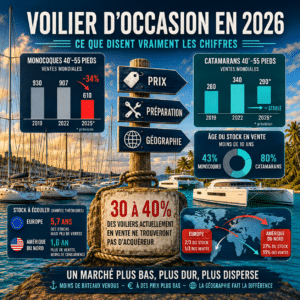

After three years of post-Covid euphoria, during which everything sold fast and at high prices, the used-boat market has completely reversed.
Supply has exploded, demand has contracted, and many owners now find themselves with a boat that is difficult to sell — or even impossible to sell.
In the Caribbean as well as in Europe, the number of boats for sale now far exceeds the market’s annual absorption capacity.
To the point that it must now be acknowledged:
up to 30% of the boats currently for sale will probably never find a buyer.
1 — The post-Covid bubble: a chapter we must definitively close
From 2020 to 2023, demand surged:
scarcity of available boats, production delays, leisure budgets redirected, travel restrictions… the market lost all reference points.
For three years, a boat could sometimes sell for more than its original purchase price, even if it was already 5 or 10 years old.
But this period was an anomaly.
We are now coming out of it, and the market is returning to an unyielding logic.
2 — Prices that have become totally unrealistic
Concrete examples:
Example 1 — 4-cabin catamaran purchased for €150,000 ten years ago
Listing it today at €160,000, without an engine refit, without new electronics, and without any major upgrades, no longer makes any economic sense.
This price level existed only during the Covid bubble — it has no justification today.
Example 2 — 4-cabin versions: the end of a cycle
For many years, 4-cabin ex-charter catamarans held their value reasonably well, because private 3-cabin owner versions were rare.
This is no longer the case.
The supply of 3-cabin owner versions has never been higher.
Private buyers now almost always prefer these models.
Meanwhile, 4-cabin ex-charters are increasingly perceived as:
- more worn,
- less desirable,
- more expensive to upgrade.
Result: their prices are collapsing.
Example:
A Lagoon 42, 7–8 years old, 4-cabin version, now sells for less than €250,000,
even though it was still selling for around €300,000 not long ago.
3-cabin versions remain attractive,
but 4-cabin boats have become extremely difficult to sell.
Example 3 — Blue-water ketches from a renowned French shipyard (1995–2000)
These boats sold for €150,000 to €200,000 in 2015.
Seeing them listed today at €200,000 to €230,000,
despite being ten years older and often requiring a full refit,
is totally incoherent.
A depreciation of at least 30% would be logical.
3 — Accelerated innovation makes 10- to 15-year-old boats “old”
A new phenomenon worsens the situation:
major shipyards are renewing their model lines faster than ever.
The Bénéteau–Jeanneau Group has announced 66 new models in three years,
a 50% increase compared to the previous period.
These new designs offer real improvements:
- redesigned interior volumes,
- optimized ergonomics,
- modernized styling,
- simplified electronics,
- better power-to-weight ratios.
Result: a 10- to 15-year-old boat looks significantly more dated today than it did a few years ago.
Even in excellent condition, it suffers from accelerated obsolescence, making resale much more difficult.
4 — A crucial reminder: a boat is not real estate
In a normal market, depreciation is inevitable:
- ≈ 30% over 5 years,
- ≈ 50% over 10 years.
The market is returning to these fundamentals, faster and more severely than expected.
5 — 2025 Statistics: what BoatWizard data really shows
(Catamarans & Monohulls – data as of 12/11/2025)
BoatWizard does not capture 100% of the market,
but it includes at least 90% of all active listings,
and likely even more in the Caribbean.
Its statistical value is therefore extremely strong.
5.1 — Catamarans: a market in oversupply
Caribbean: 387 catamarans for sale
- 73% are under 10 years old (283 units)
- 222 are under 10 years old within the 38–50 ft range
- 287 are between 38–50 ft
The majority of the stock is far too recent — a completely abnormal situation.
2025 Sales: only 92
- including 65 boats under 10 years old
- Turnover rate: 24%
→ 1 sale for every 4.2 boats listed
5.2 — Worldwide: a similar situation
- 2,100 catamarans for sale
- 1,500 under 10 years old (71%)
5.3 — USA: similar stock, but 2.5 times more sales
- 380 catamarans for sale
- 233 sales in 2025
Reasons:
- Strong US dollar → higher purchasing power
- Boats already imported / already taxed
- No customs risk
- New import duties on brand-new boats
→ massive shift from new boat purchases to used boats
A key point for our sector:
Our study focuses on the used-boat market. Yet American buyers — who previously purchased heavily in the Caribbean — now buy almost exclusively within the United States.
The USA does not “absorb global demand,” but it represents nearly 50% of worldwide buyers, who no longer purchase outside the US. This mechanically reduces demand in the Caribbean.
5.4 — Monohulls: less saturated, but weakened
Caribbean: 182 monohulls for sale
- 36 under 10 years → only 20%
- 38–50 ft segment: 105 boats, including 28 recent ones
2025 Sales: 66
→ Turnover rate: 36%
The monohull market is not saturated,
but it suffers from a massive long-term shift in demand toward catamarans.
The monohulls that sell are those whose budget does not allow for a catamaran.
Older units or those requiring a refit struggle to find buyers.
6 — What the numbers really show
- Oversupply concerns mainly recent catamarans
- The US market attracts its own buyers, reducing Caribbean demand
- The turnover rate is too low to absorb inventory
- A significant part of the current stock will remain unsold
We estimate that 30% of boats will probably not find a buyer,
even after several price reductions.
Conclusion: adjust the price… or accept keeping the boat
The 2025/2026 market demands a return to reality.
To sell today, you need:
- a realistic price,
- a clear understanding of the boat’s true value,
- a solid maintenance history,
- and the acceptance that demand is no longer what it was in 2021–2022.
Otherwise, the boat will remain at the dock, sometimes for months, sometimes for years.