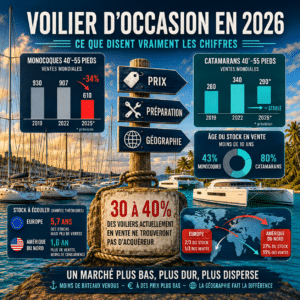

As the 2026-2027 Caribbean season opens, catamaran inventory keeps rising, and the prices of boats leaving charter fleets are beginning to redefine the value of the entire market.
Introduction
Last May, we already estimated that a significant share of the sailboats on the market was unlikely to find a buyer under normal conditions. Four months later, the imbalance has not eased. In the catamaran market, it has grown.
The market is not entirely short of buyers. It simply has far too many boats for the number of buyers available.
Since June, enquiries have fallen sharply
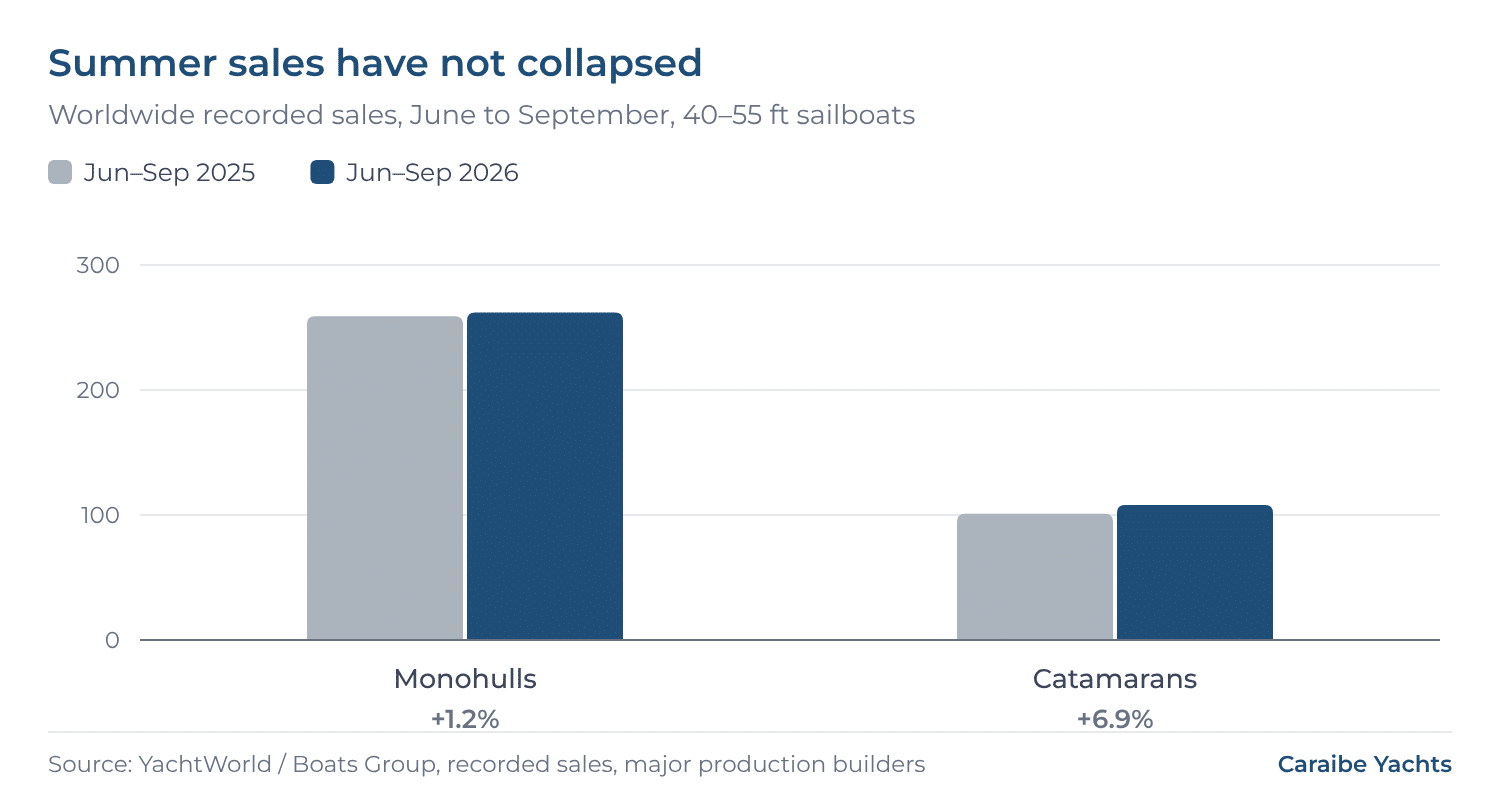
Sales recorded since June do not yet show a collapse. Between June and September 2026, they even held at the level of summer 2025. But a sale closed today is often the result of a first contact made several months earlier. To gauge where the market is heading, we need to look at new enquiries.
An analysis of enquiries on the major international listing sites shows a very sharp drop since June 2026, in the order of 40 to 50%.
Not every enquiry turns into a sale, and their volume also depends on the boats on offer. But this drop is a serious leading indicator: inventory keeps growing at the very moment new contacts are becoming scarce.
Catamaran inventory keeps rising
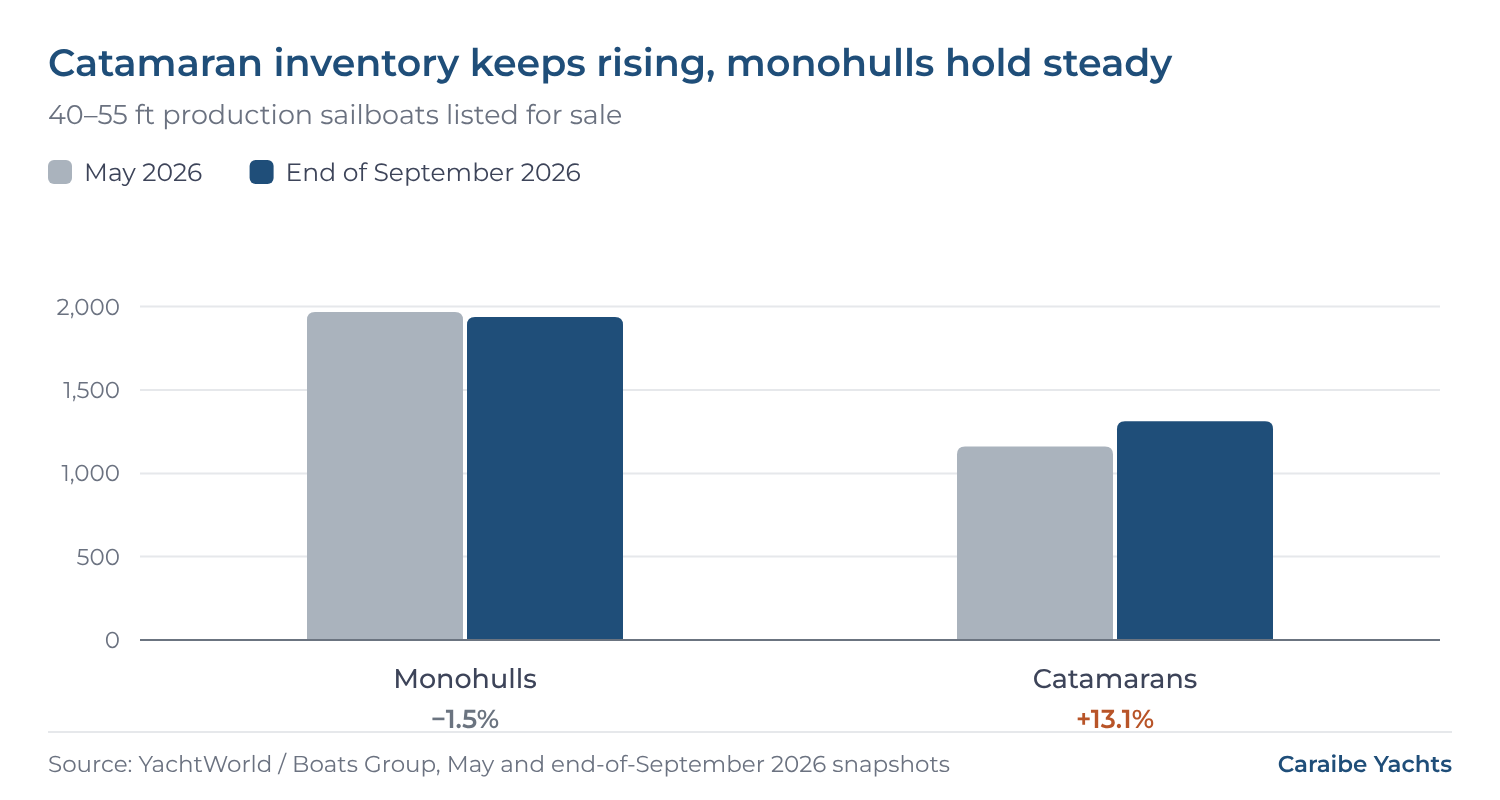
Between May and the end of September 2026, the number of 40 to 55 ft production catamarans listed on YachtWorld, Boat Trader and the other Boats Group websites rose from 1,161 to 1,313. That is 152 additional boats, an increase of 13% in four months.
Over the same period, monohull inventory remained almost stable (1,938 against 1,968). The catamaran’s specific problem is therefore no longer a feeling expressed by professionals. It can now be measured.
Recent boats face the most competition
The most counter-intuitive finding concerns the age of the boats. Catamarans under ten years old represent about four years of theoretical inventory, against just over two years for older boats. The same holds true for monohulls.
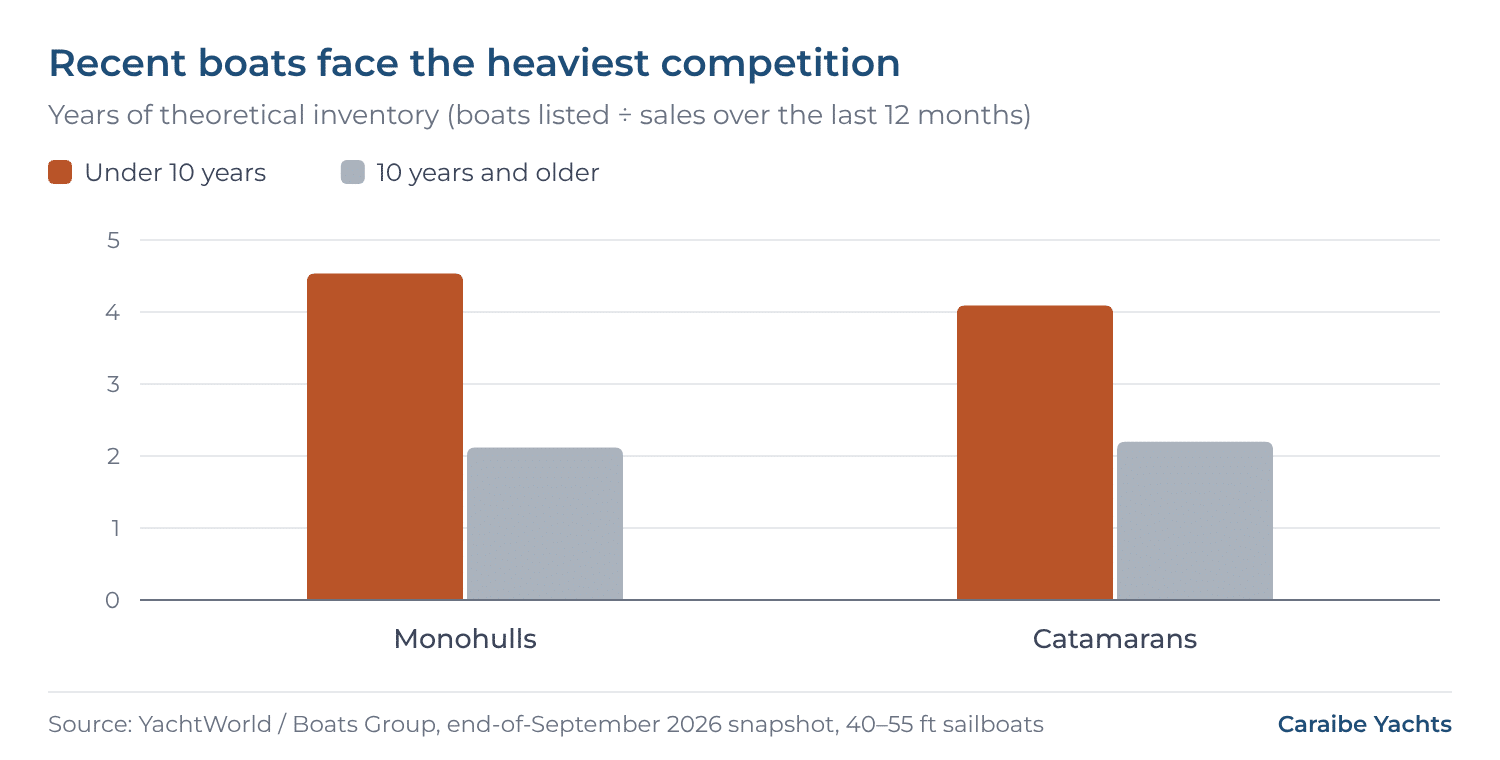
Theoretical inventory does not tell you how long a particular boat will take to sell. It measures the competitive pressure on its segment. But it clearly shows that recent boats, supposedly the most attractive, have become the most numerous relative to the buyers available.
The problem is not just the age of the boat. It lies in the abundance of comparable models and in prices still largely shaped by the post-Covid period.
The charter engine is seizing up
For nearly twenty years, a large share of catamaran production relied on a simple mechanism: a private individual invested in a new boat, which was operated for several years by a charter company, then sold to a private sailor when it left the fleet. A new investor then financed its replacement.
Today, both ends of this system are weakened. Management programmes attract fewer investors, and the used market struggles to absorb the boats leaving the fleets.
Fewer buyers finance new boats, and fewer private sailors take over the old ones. Inventory no longer clears: it renews itself.
Charter companies are changing the rules
Our end-of-September survey of Dream Yacht, Navigare, Moorings and Sunsail shows 316 boats listed for sale, nearly half of them catamarans. Around 75 of these catamarans are in the Caribbean.
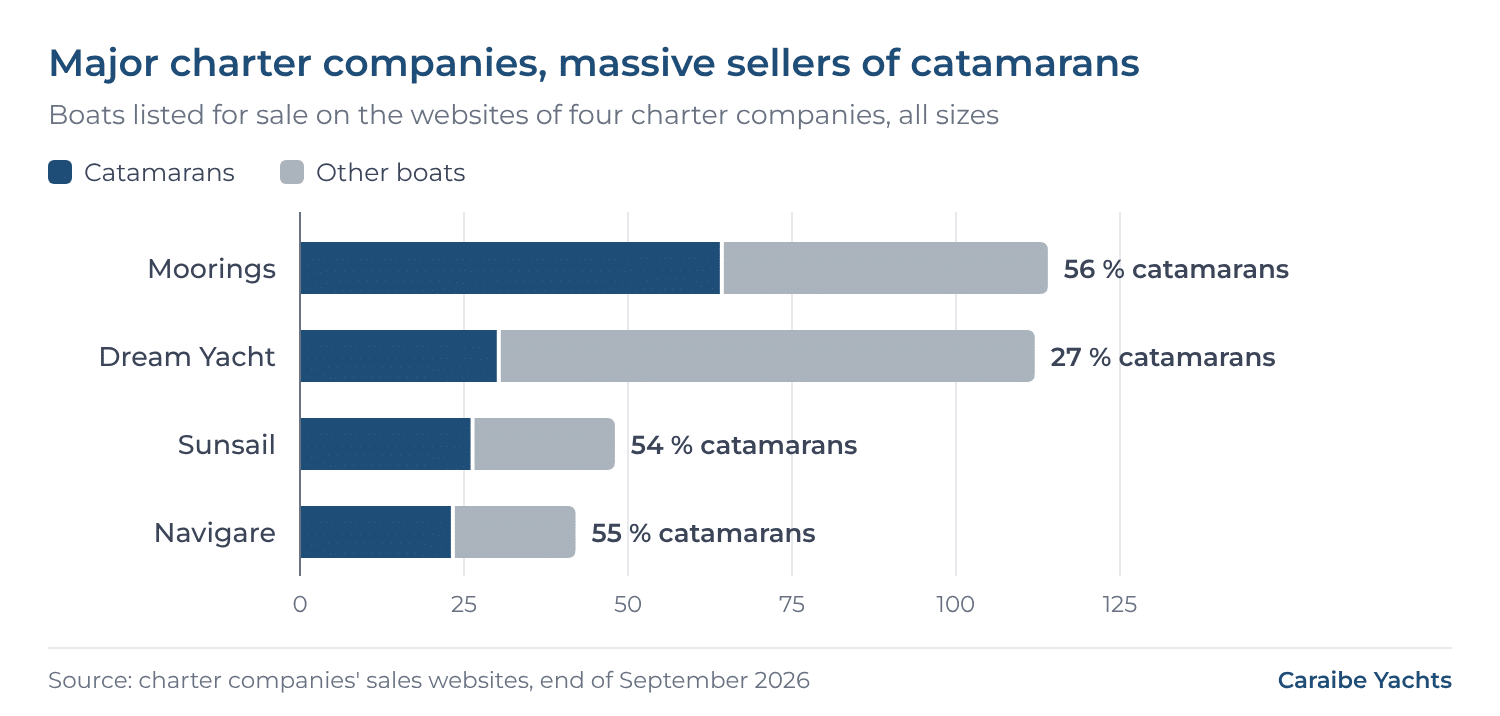
Most are under ten years old, and mainly under seven.
Yet these four companies are only the visible part. The Caribbean has dozens of other charter operators, who also mainly sell catamarans. Across the whole region, eight out of ten catamarans for sale are under ten years old, and fewer than one in five is a three-cabin owner’s version. Among catamarans under ten years old, the proportion falls to about one in six: most of the recent supply comes from charter fleets.
Through their volume, their international reach and their ability to grant substantial discounts, charter companies no longer simply feed the used market. They now help set its prices.
The Caribbean is still selling, but it has to absorb everything
The Caribbean remains an active market. It benefits from an international clientele, its proximity to North America and the possibility of buying a boat directly in an attractive cruising ground.
It even holds up slightly better than the world average for some recent catamarans. But this advantage is absorbed by the constant arrival of boats leaving charter fleets. Across the segment as a whole, the theoretical time to clear inventory is practically the same as the world average.
The Caribbean is not a market in crisis. It is an active market being asked to absorb a volume that has become excessive.
The US market looks more liquid, but not necessarily stronger
The United States accounts for a large share of the sales recorded since June, and its theoretical inventory is absorbed faster than that of Europe or the Caribbean. This greater liquidity does not, however, prove that American demand is growing: between June and September, US catamaran sales fell compared with 2025.
American buyers have always represented a large share of purchasers in the Caribbean, and they seem to be holding up better than European buyers.
A boat already imported and duty-paid in the United States may keep an advantage over one subject to new taxes. But this advantage applies to certain individual boats. It is not enough to turn the US market as a whole into a growth market.
A €100,000 gap changes the buyer’s plan
In the Caribbean, private buyers generally prefer three-cabin owner’s versions that have never been chartered. This preference is still real, but it now has a ceiling.
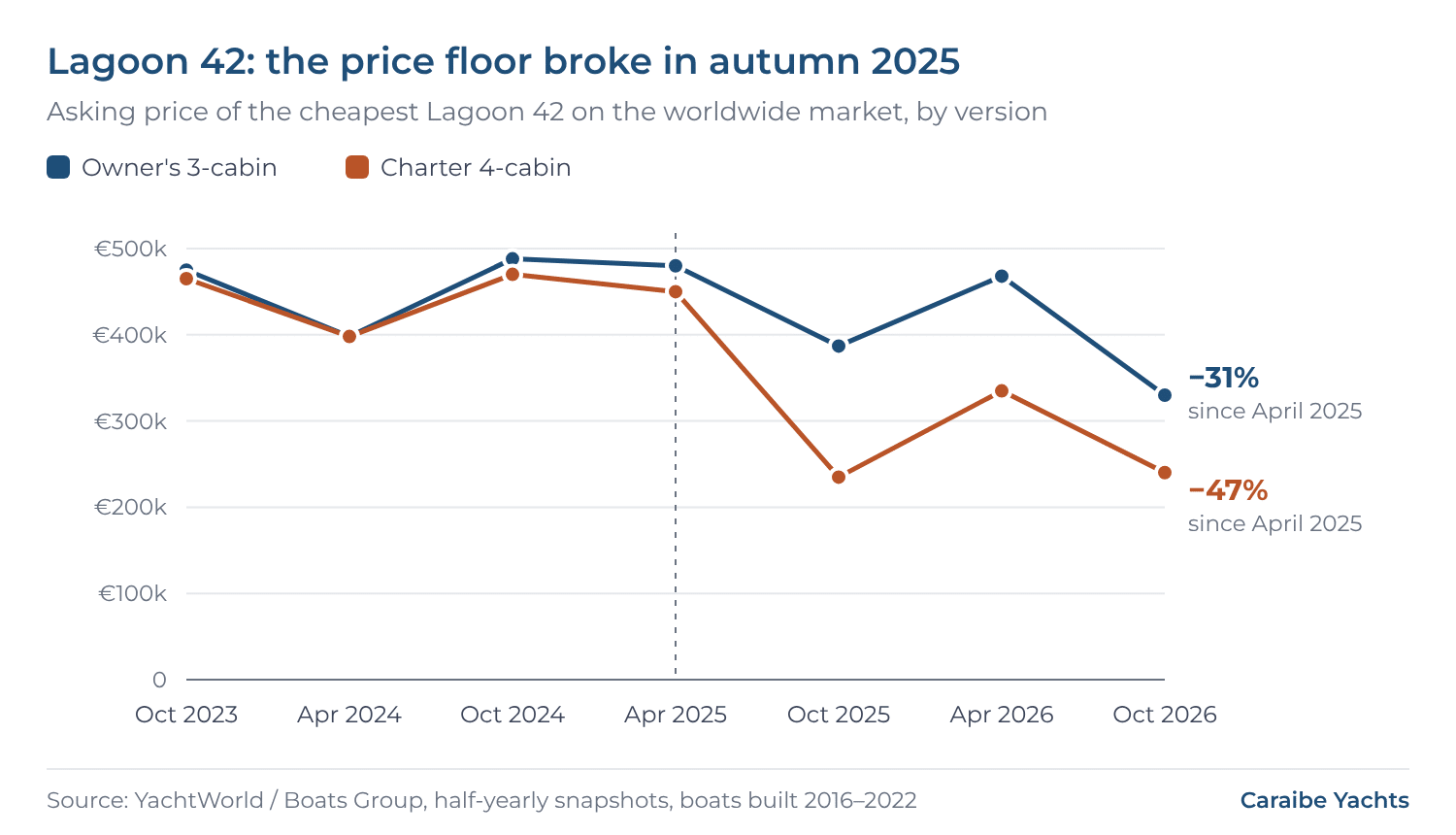
An owner’s version Lagoon 42 can today be listed at around €330,000, while a four-cabin ex-charter boat of comparable age is offered at around €240,000. With a gap of nearly €100,000, even a buyer who was initially looking for an owner’s version starts to hesitate. They can choose the charter boat and keep part of the savings for work and refitting. The owner’s version remains objectively superior and still commands a premium, but ex-charter boats are increasingly setting the maximum premium a buyer will agree to pay.
The charter companies’ aggressive pricing therefore does more than bring down ex-charter boats. It puts pressure on every boat of the same model.
Our survey of the cheapest Lagoon 42, all markets combined, shows when the break happened. Until spring 2025, charter and owner’s versions sat in the same price range. In autumn 2025, the price floor of ex-charter boats dropped away, and that of owner’s versions followed: a fall of about 30% in eighteen months.
Post-Covid prices are still resisting the fall
For a long time we considered that a boat lost roughly 30% of its value in five years and 50% in ten. These benchmarks were reasonable in a normal market.
But the surge in prices during and after Covid profoundly changed the starting point. Owners still often reason from the price they paid or the value reached at the top of the market. Buyers now reason from the considerable choice available to them.
A boat may already have lost 30% from its post-Covid price and still be too expensive. The old depreciation rules were benchmarks, not a guarantee of residual value.
In a saturated market, price becomes a ranking tool
Condition, preparation, equipment, presentation and location still matter. But when several comparable boats are available, price becomes the deciding factor in selling quickly.
In a saturated market, the asking price is no longer just an estimate of value. It is a ranking tool.
An overpriced boat does not necessarily receive a lower offer. Above all, it risks receiving no offer at all. While its owner waits, costs keep running, new competitors arrive and the listing gradually loses visibility.
Price alone is therefore not enough: timing matters just as much. In a queue, the first seller to drop below the competition captures the buyers available. The one who reduces after the others gains no ground. They join them at the back of the queue, with a listing that is no longer new, and often have to cut further to get noticed.
You have to be cheaper before the others. After that, it is too late: waiting no longer protects value, it destroys it.
Not every boat will sell
Part of the inventory will be withdrawn from sale. Some boats will be kept reluctantly. Others will sit for several seasons before suffering a far larger reduction than the one that would have sold them in the first place.
A well-maintained, well-prepared, well-documented and correctly positioned boat still has a real chance of finding a buyer. But not every boat can be offered at the top of the market. Only the most attractive in their category will capture the first buyers.
What about monohulls?
The mass-production monohull is losing ground year after year, and charter companies have sharply reduced their monohull fleets. Only boats from yards specialising in bluewater cruising are really holding up, such as Amel, with whom we work.
For several years now, the choice between a monohull and a catamaran has above all been a question of budget. Put simply, monohulls were sold to buyers who did not yet have the minimum budget for a catamaran.
Yet falling catamaran prices are lowering precisely that threshold. Today, older monohulls still sell because they remain the cheapest way in. That is exactly the place falling catamaran prices will now contest, particularly in the Caribbean, with the exception of boats designed for bluewater cruising.
Boats leaving charter fleets will have the same effect here as on catamarans. Fewer in number, the monohulls sold off by charter companies will also set the price floor for their model and pull down every comparable boat.
Modern monohulls have also made great progress in design and ergonomics. If their prices fall in turn, older monohulls will become very difficult to sell. Many of them will no doubt be among the boats that will not sell.
Conclusion
The catamaran market is not entirely short of buyers; it simply has far too many boats for the number of buyers available. The drop in new contacts since June now reinforces this finding. The Caribbean and the United States remain active markets, but their activity is not enough to absorb the supply that keeps arriving.
In this market, price is no longer just the expression of a boat’s supposed value. It determines its place in the queue. And in that queue, those who reduce first move to the front.
The real question is therefore no longer just: “What is my boat worth?”
It has become: “At what price will my boat be one of those that sell?”
We know this picture is not very optimistic, and that it contrasts with what is often heard in our industry. But our role is to tell our clients what the figures show, not what they would like to hear. And on this point, we would genuinely love to be proved wrong.